
Science at the edge of Space
Deep dive into meteorology and telemetry with precision. Work as a Payload ntegration expert, Flight computer specialist, Launch operations lead, Meterologist, Safety Officer or a Flight Director.
…And launch and retrieve a High Altitude Balloon that travels through the atmosphere upto 100,000 feet and learn about the weather, and see the earth’s curvature.
Learn as an Individual Succeed as a Team
Participate in a 4-day high altitude balloon mission. Build, test, and fly your experiments to the edge of space in this exciting and educational camp.
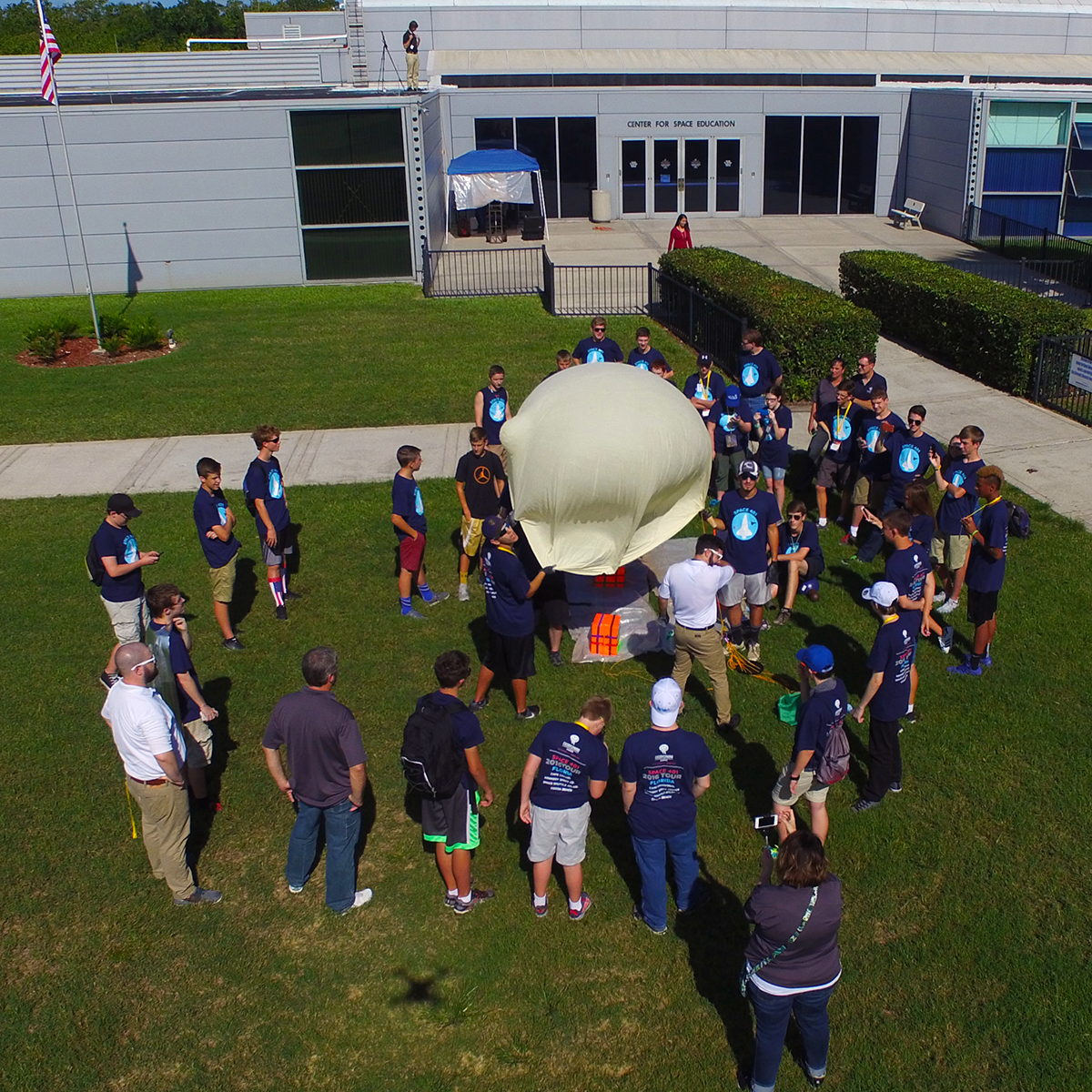
Students/participants are assigned to independent teams with positions similar to those used by NASA, including Flight Director, Safety Officer, Payload Integration, Launch Operations, and Meteorology. Instructors will train students/participants to perform their tasks and then assist in operations as the students take the lead.
Develop a meteorology payload
Develop and intergrate a payload destined for the stratosphere, enabling you to conduct experiments and collect data.

Collect invaluable atmospheric data
Collect atmospheric data such as humidity, pressure, temperature, velocity, and altitude.
Explore electronics and sensors
Explore a variety of sensors, and the intricate workings of the electronics on your flight computer.

Launch a Helium Balloon upto 100,000 feet
Launch a Helium Balloon upto 100,000 feet into the atmosphere

Learn to analyse and present data
Learn to analyse and present data from the experiments conducted throughout the balloon’s flight.

Witness Earth’s curvature
Witness Earth’s curvature and breathtaking images from the balloon’s flight
Camp Details
Sensors and Telemetry
Students learn how real missions measure and communicate during a balloon flight. They’ll work with core atmospheric sensors (temperature, pressure, humidity, and GPS/altitude concepts). The focus is on building intuition for accuracy, sampling rates, calibration, and how data behaves as the balloon climbs through different layers of the atmosphere.
Payload Integration
tudents assemble a complete near-space payload by integrating electronics, sensors, power, and mechanical mounting into a flight-ready system. They’ll learn why cable management, strain relief, insulation, enclosure design, and connector reliability matter—especially in cold, low-pressure environments.
Teamwork and Innovation
Near-space missions are built by teams, and students practice the same collaboration patterns used in engineering programs: assigning roles, managing time, documenting decisions, and iterating quickly when something doesn’t work. They’ll brainstorm solutions, test ideas, learn from failures, and improve designs based on evidence. The emphasis is on creative problem-solving with engineering discipline—turning “cool ideas” into working systems.
Data Collection and Analysis
Students don’t just launch — they learn to extract meaning from the mission. They’ll collect atmospheric datasets during flight, organize the results, and analyze trends across altitude and time. Using graphs and basic interpretation techniques, they’ll connect observations to real atmospheric behavior and communicate findings clearly, just like a mission debrief: what happened, why it happened, and what they would improve next time.
Critical Thinking
Students learn to think like investigators—asking the right questions, challenging assumptions, and using evidence to guide decisions. They’ll troubleshoot unexpected behavior in sensors, power, or telemetry by forming hypotheses, testing them, and refining their approach based on results. The goal is to build disciplined problem-solving habits that translate directly to engineering, science, and real-world decision-making.
Systems Engineering
Students experience how complex projects succeed when every subsystem works together. They’ll learn to define requirements, understand interfaces (power, data, mechanical), and manage trade-offs like weight vs. durability or performance vs. simplicity. By testing components individually and then validating the integrated payload as a whole, they practice the systems mindset used in aerospace programs: design, integrate, verify, and iterate.
- All students, along with the experience of a lifetime, will receive certificates of excellence upon program completion. The winning team will receive medals commemorating their success.
- In addition to class activities, all students will learn about the history of the U.S. space program and visit several attractions in the KSC Visitor Complex. Including the Space Shuttle Atlantis, Gateway, IMAX movies and other attractions based on camp duration.
Camp Schedule

This day serves as an introduction to Space Trek and provides students with an engaging introduction to programming. Students will then learn the basics of their robot and be prompted to work on challenges. Exciting park activities will be included throughout the day with exhibits such as Gateway and IMAX movies.
This day serves as an introduction to Space Trek and provides students with an engaging introduction to programming. Students will then learn the basics of their robot and be prompted to work on challenges. Exciting park activities will be included throughout the day with exhibits such as Gateway and IMAX movies.
Inclusions
Mission instruction, materials, and guided build time
Team-based challenges, evaluations, and graduation recognition
All students, along with the experience of a lifetime, will receive certificates of excellence upon program completion. The winning team will receive medals commemorating their success.
Access to key KSC Visitor Complex learning experiences (subject to availability) – Shuttle Launch Experience, IMAX Movie Shows, The Explorer Bus Tour, access to various KSCVC exhibits, Shop at the biggest Space store.
- Lunch & Snacks are included during the duration of the camp
Disclaimer: The schedule accommodates KSCVC activities, with adjustments based on group size and punctuality. While every effort is made to adhere to the schedule, activities may be altered or removed to ensure program timelines are maintained. Event times and availability are subject to change without notice.